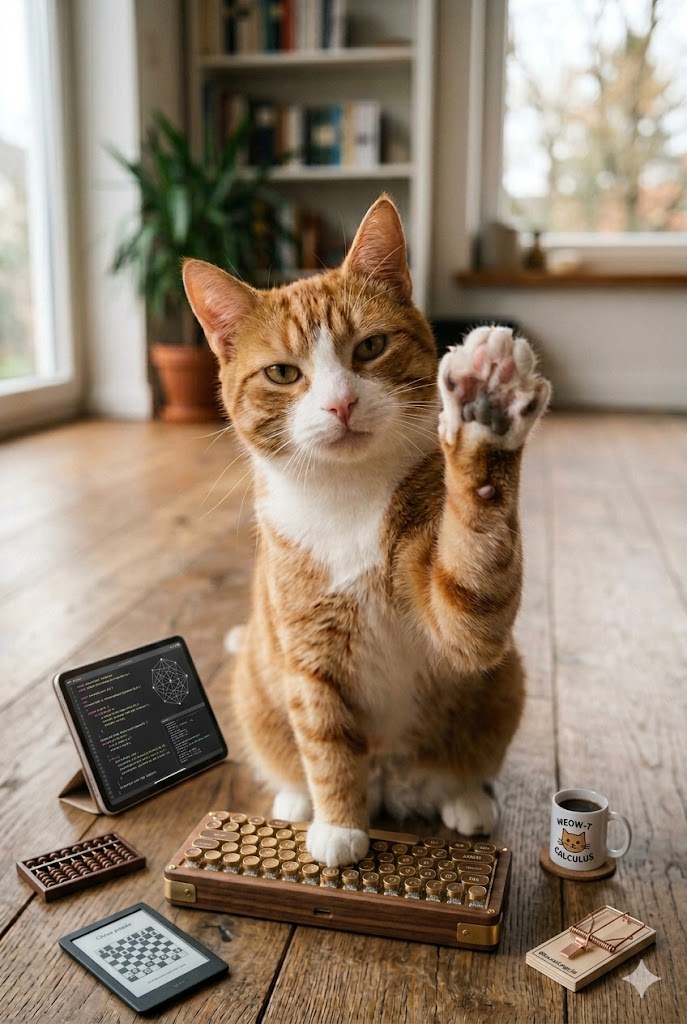
Ask most people to rank the intelligence of common pets and dogs will invariably come out on top. Cats, the thinking goes, are beautiful but dim — or at best, indifferent to the kind of tasks that measure animal intelligence. The dog fetches, responds to commands, and performs. The cat watches, judges, and declines.
This reputation is almost entirely wrong, and it has a straightforward explanation: for decades, cat intelligence was measured using tests designed for dogs and primates, in laboratory conditions that cats find profoundly stressful and unnatural. Unsurprisingly, cats performed poorly. When researchers began studying cats on their own terms — in their own environments, on tasks relevant to their natural behaviour — a very different picture emerged.
Cats are not less intelligent than dogs. They are differently intelligent, shaped by a different evolutionary history and a different set of cognitive priorities. And in several specific areas, they are more capable than almost anyone had assumed.
The Problem With How We've Measured Cat Intelligence
Animal intelligence research has historically been dominated by the dog, for good reason: dogs are highly motivated to please humans, they work well in laboratory conditions, and they have been selectively bred for thousands of years to follow human social cues. They make excellent research subjects. Cats do not. A cat placed in an unfamiliar laboratory with a stranger and asked to perform a task will typically respond by sitting down and staring at the wall — not because it cannot do the task, but because it has decided not to.
This is not stupidity. It is independence. A 2021 study found that cats perform significantly better on cognitive tasks when tested at home by their owners rather than in laboratory settings. The same tasks that cats "failed" in labs, they passed at home. The environment, not the intellect, was the variable.
What Cats Are Genuinely Good At
When studied appropriately, cats demonstrate sophisticated cognitive abilities across several domains:
Cats vs Dogs: A Fairer Comparison
The dog vs cat intelligence debate is largely a false one, because the two species were shaped by different evolutionary pressures to solve different problems. Dogs evolved as pack animals and later as human working partners — their intelligence is highly social, collaborative, and oriented towards reading and responding to human intentions. Cats evolved as solitary hunters — their intelligence is independent, spatial, and oriented towards tracking, stalking, and problem-solving alone.
In tasks that reward social collaboration and human-directed behaviour, dogs reliably outperform cats. In tasks that reward independent problem-solving, spatial reasoning, and persistence without human encouragement, cats often match or exceed dogs. A 2016 study at Péter Pongrácz's Budapest laboratory found that cats were actually more persistent than dogs at solving a puzzle box after initial failure — dogs gave up and looked to their owners for help, while cats continued trying independently.
The Cerebral Cortex: Raw Processing Power
On a purely neurological level, cats have approximately 300 million neurons in their cerebral cortex — compared to around 160 million in dogs. The cerebral cortex is the region responsible for planning, decision-making, and complex problem-solving. This does not make cats "smarter" in any simple sense — neural density is only one of many factors in cognitive ability — but it does suggest that the assumption of feline cognitive inferiority has no anatomical basis.
Can You Make Your Cat Smarter?
Cognitive ability in cats, as in most mammals, is partly fixed and partly responsive to environment and stimulation. Cats that are regularly engaged with puzzle feeders, interactive play, and social interaction show better cognitive performance and slower age-related cognitive decline than under-stimulated cats. Environmental enrichment — vertical space, novel objects, hunting-simulation play — is not just about entertainment. It actively maintains and develops feline cognitive function.
The smartest thing you can do for your cat's intelligence is to stop measuring it by dog standards — and start engaging with it on its own terms.