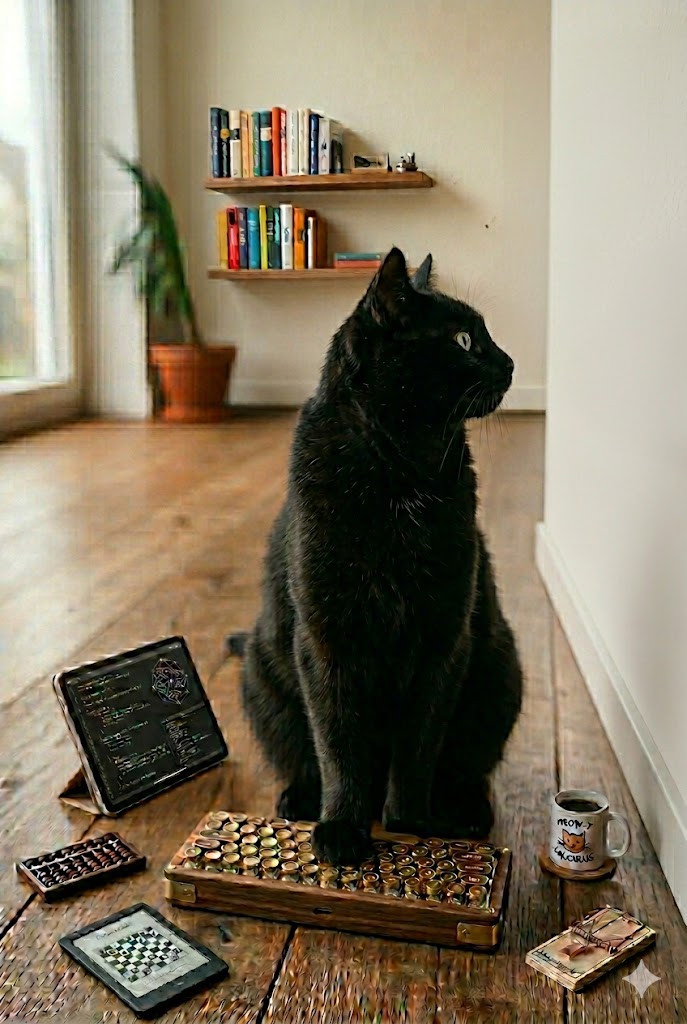
You are watching television when you notice your cat has been sitting motionless for several minutes, staring at a perfectly blank section of wall. Its eyes are fixed. Its ears rotate forward. Then, after a long pause, it walks away as if nothing happened. You are left with the distinct and unsettling sense that your cat knows something you do not.
It turns out, it probably does. The wall-staring behaviour that owners find so uncanny is almost always explicable by feline biology — and specifically by the remarkable degree to which a cat's sensory world differs from our own. What looks like a blank wall to a human is, to a cat, a surface full of acoustic, olfactory, and sometimes visual information.
Most of the time, the explanation is mundane. Occasionally, however, wall-staring can be a signal worth taking seriously — and knowing the difference matters.
What Cats Can Hear That We Cannot
The most common explanation for wall-staring is simply that the cat can hear something inside the wall. Cats have one of the most impressive auditory ranges of any domestic animal, capable of detecting frequencies between 48 Hz and 85,000 Hz. Humans hear between roughly 20 Hz and 20,000 Hz. This means cats are sensitive to ultrasonic sounds — the high-frequency squeaks and movements of mice, rats, insects, and other small animals — that are entirely inaudible to us.
Walls in domestic homes are routinely inhabited by mice, rats, squirrels, birds nesting in cavities, insects, and plumbing that produces high-frequency vibrations. A cat sitting apparently staring at nothing is very likely tracking a sound source with extraordinary precision. The cat's outer ear (pinna) can rotate up to 180 degrees independently, acting as a directional microphone. The animal may be triangulating the position of a sound to within centimetres.
What Cats Can Smell Inside Walls
Cats possess approximately 200 million scent receptors in their nasal passages — compared to roughly 5 million in humans. They also have the Jacobson's organ (vomeronasal organ) in the roof of the mouth, which detects chemical signals that bypass the standard olfactory system entirely. The scent of another animal — its urine, pheromones, or body odour — can permeate through drywall, plaster, and brickwork in concentrations a cat can detect but a human cannot begin to sense.
A cat that seems to be staring at a wall near floor level, perhaps accompanied by pawing or sniffing, is very frequently responding to scent rather than sound. The prey drive this triggers is powerful — it can hold a cat's attention for long periods even with no visible stimulus.
Light, Shadows, and the Feline Visual System
Cats' eyes contain a high proportion of rod photoreceptors, making them highly sensitive to movement and low-level light. The tapetum lucidum — the reflective layer behind the retina that makes cats' eyes glow in the dark — amplifies available light significantly. This means cats can detect the flicker of a shadow, the movement of a tiny insect, or the reflection of light from a surface in ways that are simply below the threshold of human perception.
A spider on the wall, a mote of dust caught in a beam of light, a faint shadow cast by movement outside a window — all of these can trigger sustained visual attention in a cat that appears, to its owner, to be staring at absolutely nothing.
When to Be Concerned: Feline Hyperaesthesia Syndrome
In a small minority of cases, repetitive or frantic staring — particularly when accompanied by skin rippling along the back, sudden biting or scratching at the tail, dilated pupils, and apparent hallucinations — may indicate feline hyperaesthesia syndrome (FHS), a neurological condition sometimes called "rolling skin disease" or "twitchy cat disease."
FHS is relatively rare and is distinct from normal wall-staring behaviour. The key differentiators are the involuntary nature of the movements, the skin rippling, and the apparent distress of the cat during episodes. Isolated, calm, curious wall-staring — which is what most owners observe — is almost never a sign of FHS.
Should You Do Anything?
In most cases, no intervention is needed. The cat is doing exactly what it was designed to do: paying close attention to environmental information. However:
- If the behaviour is new and sudden in an older cat, it can occasionally reflect cognitive changes and is worth mentioning to a vet.
- If it is accompanied by skin rippling, vocalisation, or self-harm, seek veterinary advice promptly.
- If the cat is staring at the same spot repeatedly over days, it may indicate a pest problem worth investigating — cats are often better at detecting infestations early than any human occupant of the building.
- In most cases, it simply means your cat's extraordinary senses are working exactly as they should.
The next time your cat stares at the wall, the most accurate interpretation is probably the simplest one: there is something there. You just cannot detect it.