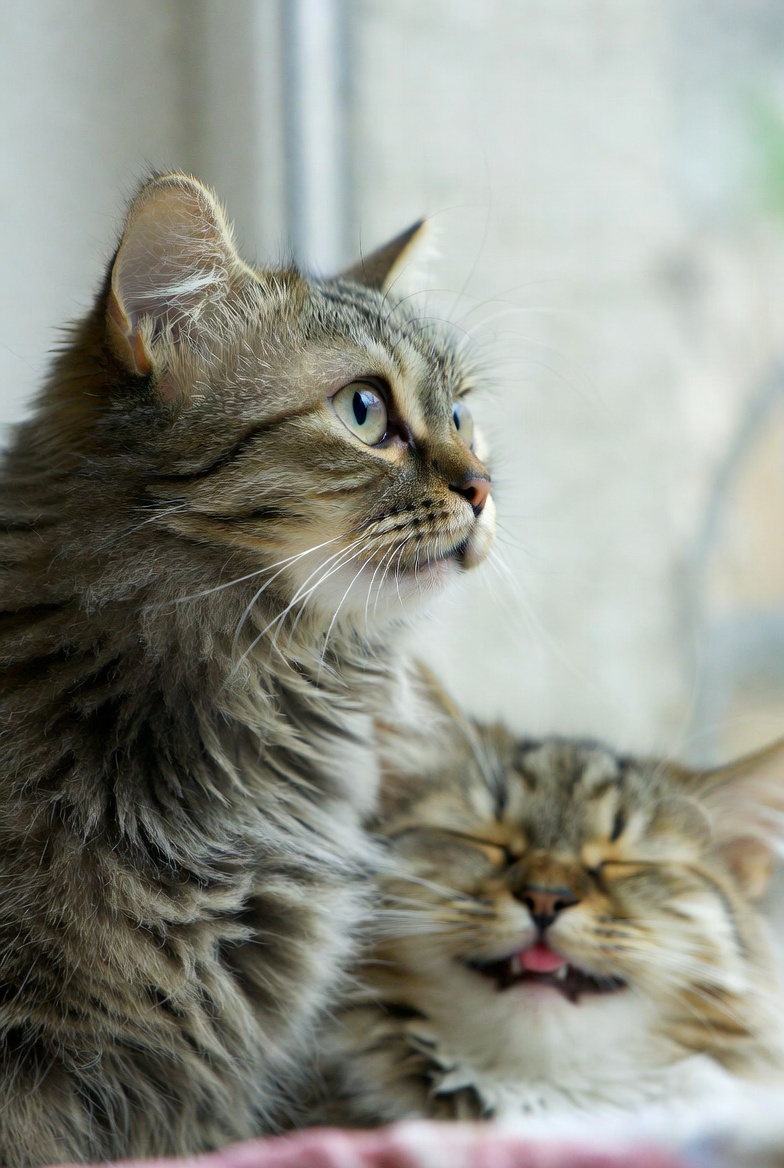
You are scrolling your phone when your cat climbs directly onto the screen. You stroke a friend's dog and your cat sulks for the rest of the evening. You bring a new kitten home and your resident cat begins over-grooming. If these scenes feel familiar, you have probably wondered: is my cat jealous?
The answer depends on how strictly you define the word — and what science currently has the tools to measure. Jealousy is a complex emotion in humans, involving a perceived threat to something we value — a relationship, a position, a source of security. Whether cats experience anything that genuinely maps onto that internal state is a question researchers are only beginning to take seriously.
What is clear, even now, is that cats are far more emotionally sophisticated than their reputation for cool indifference suggests. They form genuine attachments, they notice when those attachments are disrupted, and they respond in ways that are strikingly consistent with what we call jealousy — even if the underlying experience may differ from our own.
What Jealousy Actually Is
Psychologist David Buss defines jealousy as an evolved emotion that arises when one perceives a threat to an important relationship or resource. By that definition, jealousy requires three things: an attachment, a perceived rival, and a response to protect the attachment. Cats, as research increasingly confirms, have all three — but whether the subjective experience accompanying those behaviours resembles what humans feel when jealous remains genuinely unknown.
What science cannot confirm is whether cats experience envy in the strict sense — the cognitive desire for something another individual possesses. Cats lack the rigid social hierarchies that drive status-based envy in humans. But "not envious" and "not jealous" are not the same thing.
The Stuffed Cat Experiments
The most direct research on feline jealousy comes from a 2020 study by Bucher and colleagues, conducted with 52 cats across homes and cat cafés in Japan. Researchers visited each cat's home with two objects: a realistic stuffed cat (the "social rival") and a furry pillow of similar colour and texture (a non-social control).
When owners petted and spoke to the stuffed cat, the real cats paid significantly more attention to it than when a stranger performed the same action. Some cats intervened — approaching, pawing at, or positioning themselves between their owner and the stuffed rival. The researchers acknowledged that cats were clearly responding to a perceived threat to their social bond.
Resource Competition vs. True Jealousy
Animal behaviourists draw a useful distinction between jealousy and territorial resource competition. Cats are, by nature, territorial animals. Their sense of security is deeply tied to access to food, resting spots, litter boxes, and — critically — human attention. When a new pet arrives, or a human's attention is diverted, the cat's response may be less about emotion and more about security.
A cat that knocks your phone out of your hand is not necessarily jealous of the technology. It is experiencing a frustrated desire for engagement, reacting to restore a familiar routine that makes it feel safe. That said, the line between these explanations is genuinely thin: attachment disruption, resource competition, and jealousy all produce the same physiological stress response — elevated cortisol, disrupted behaviour, increased vocalisation.
Common Triggers for Jealousy-Like Behaviour
What to Do
The practical response to jealousy-like behaviour is the same whether the cause is "true" jealousy or territorial stress: increase predictability, distribute attention fairly, and ensure every cat has its own resources.
- Provide separate food bowls, litter boxes, and resting spots for each cat in multi-cat households.
- Use pheromone diffusers (such as Feliway) to reduce ambient territorial anxiety.
- Spend dedicated one-on-one play sessions with each cat individually.
- Introduce new pets gradually, using scent swapping before any face-to-face contact.
The honest conclusion is this: whether or not your cat is experiencing jealousy the way a human does, something very real is happening when their bond with you feels threatened — and it deserves to be taken seriously.