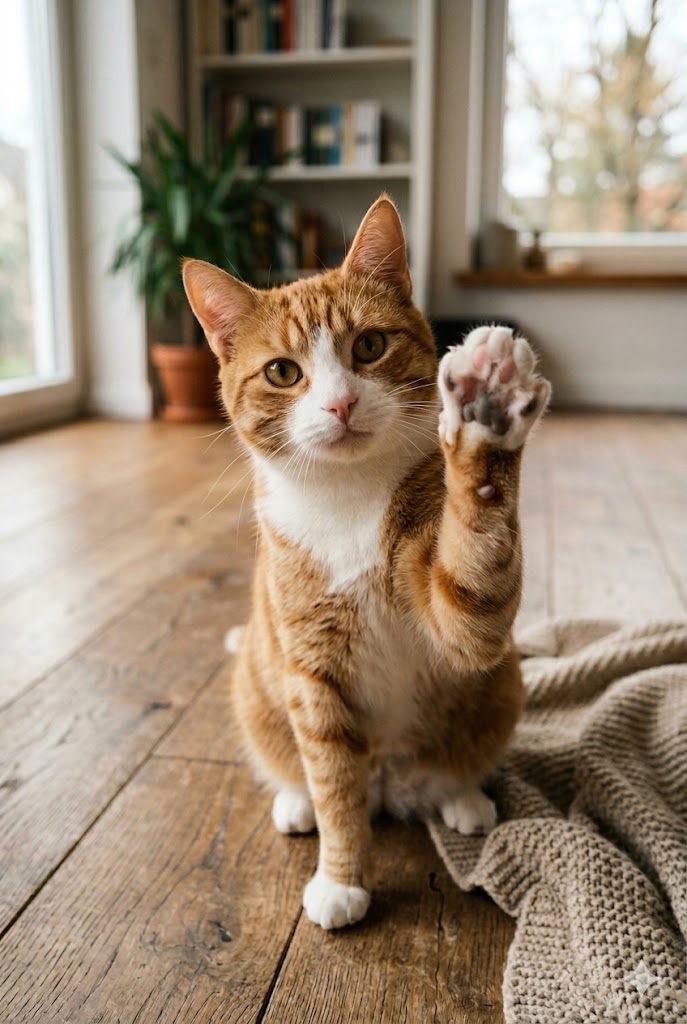
You have probably never thought to ask which paw your cat favours. It seems like the kind of detail that only a very dedicated cat scientist would notice. But it turns out that feline paw preference is a well-documented, scientifically studied phenomenon — and what it reveals about your cat's brain, personality, and even its emotional resilience is genuinely surprising.
Cats, like humans, have a dominant side. And the way that dominance is distributed — which paw they reach with first, which eye they use to track prey, which nostril they lead with when investigating a scent — reflects deep patterns of brain organisation that link all the way to how the animal handles stress, makes decisions, and responds to the world around it.
Better still: finding out which paw your cat prefers takes about ten minutes and a treat. It is one of the most accessible experiments in animal cognition you can run at home.
The Science of Laterality
Laterality — the tendency to favour one side of the body over the other — is not unique to humans. It has been documented in fish, birds, primates, horses, dogs, and cats. It reflects an underlying asymmetry in the brain: the left hemisphere and right hemisphere specialise in different functions, and in most animals, one hemisphere is more dominant than the other for particular tasks. This dominance expresses itself physically as a preference for the limb controlled by the dominant hemisphere.
In humans, approximately 90% of people are right-handed, reflecting strong left-hemisphere dominance at the population level. Cats show a different pattern: roughly equal numbers are left-pawed and right-pawed, with a smaller proportion showing no consistent preference. This absence of population-level bias is itself scientifically interesting — it suggests that the selective pressure that pushed human handedness strongly towards the right did not operate on cats in the same way.
Male vs Female: A Striking Difference
One of the most consistent findings in feline laterality research is a sex difference. Multiple studies, including foundational research by Dr Deborah Wells at Queen's University Belfast, have found that:
- Female cats tend to show a preference for the right paw.
- Male cats tend to show a preference for the left paw.
- Both sexes show stronger and more consistent laterality after neutering, suggesting that sex hormones influence paw preference.
This sex-linked pattern mirrors findings in other species and is thought to reflect the different hormonal environments during foetal brain development, which influence how strongly each hemisphere develops relative to the other.
What Paw Preference Reveals About Personality
A landmark 2014 study published in the journal Animal Behaviour by Quaranta and colleagues found that paw preference in cats correlates with distinct personality and behavioural traits. Right-pawed cats tended to be calmer, more sociable, and more confident in novel environments. Left-pawed cats tended to be more reactive, more cautious in new situations, and displayed higher levels of stress-related behaviour.
This connects to broader research in animal laterality showing that right-hemisphere dominant animals (which tend to be left-pawed) are generally more reactive to threat and negative stimuli, while left-hemisphere dominant animals (right-pawed) tend to respond more positively to social and novel stimuli. The hemisphere that controls each paw also tends to be the one that dominates emotional processing for that individual.
Ambidextrous Cats: The Stressed Middle Ground
Cats that show no consistent paw preference — using both paws equally across tasks — may, counterintuitively, be the most stressed of all. Research by Dr Wells found that ambilateral cats (those without a strong preference either way) showed significantly higher levels of anxious behaviour, aggression, and sensitivity to environmental change than cats with a clear dominant paw.
A strong laterality, the thinking goes, reflects efficient hemispheric specialisation — each side of the brain is doing its assigned job reliably. The absence of strong laterality may reflect less efficient brain organisation, which in turn is associated with higher emotional reactivity and less effective stress regulation.
How to Test Your Cat's Paw Preference
The standard method used in research is simple and cat-owner friendly:
- Place a small treat or piece of food inside a narrow tube or jar that requires your cat to reach in with one paw to retrieve it.
- Record which paw your cat uses first across at least 100 trials, spread over several sessions. (Fewer trials produce unreliable results.)
- A cat that uses one paw more than 65% of the time across 100 trials is considered to have a genuine preference for that paw.
- You can also note which paw leads when the cat steps down from a surface, which paw reaches first when playing, and which side the cat tends to sleep on.
The result will not change your cat's personality — but it may help you understand it. A left-pawed cat that seems more anxious and reactive is not badly behaved. Its brain is wired to process the world with a slight bias towards caution and threat detection. That calls for patience, predictable routines, and an environment that minimises unnecessary stress.
Your cat has been telling you about its inner life with every paw it reaches out. You just needed to know which one to watch.