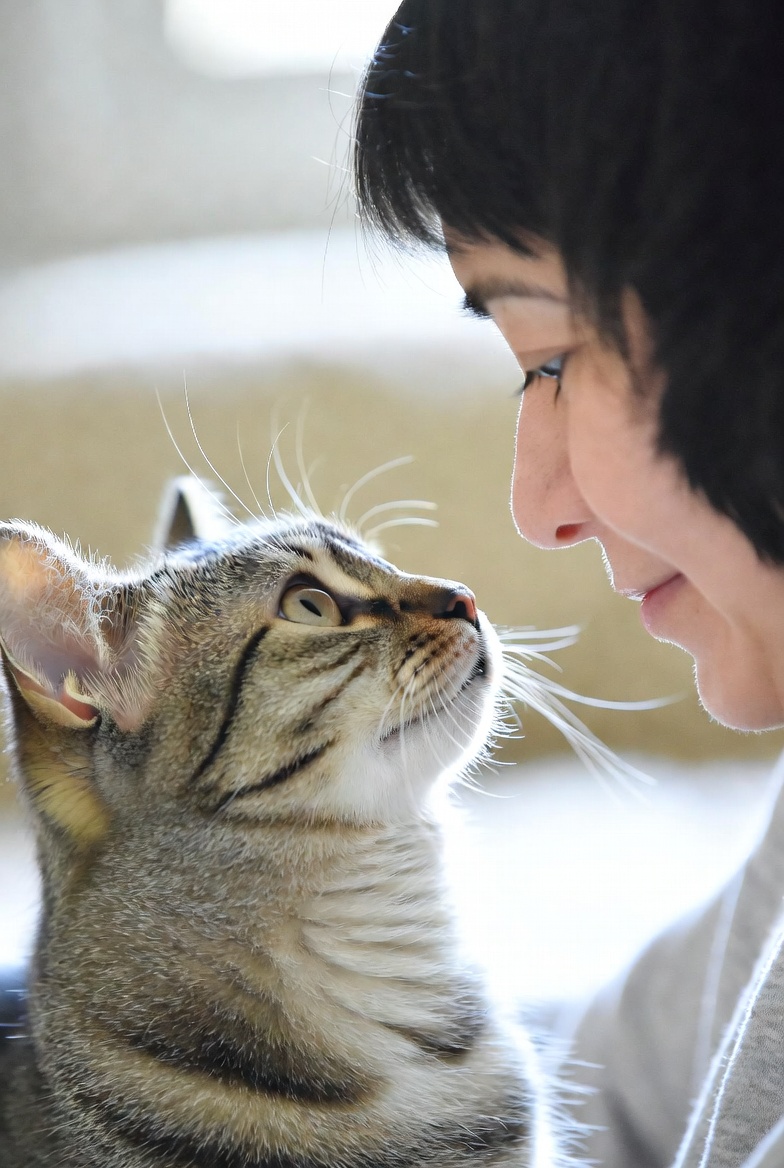
Ask a cat owner whether their pet loves them and you will likely get an emphatic yes. Ask a sceptic and they will cite the famous Japanese study where cats recognised their owner's voice but couldn't be bothered to react. The truth, as usual, sits somewhere far more interesting than either camp admits.
For decades, the dominant scientific view held that cats were essentially solitary opportunists — animals that tolerated human company because it came with a reliable food source, not because they felt anything resembling attachment. That view has been steadily dismantled by a new generation of feline cognition research. Scientists studying cat behaviour in home environments, rather than in laboratories, have found something quite different: cats that seek proximity, that show measurable hormonal responses to contact, and that use their owners as a psychological safe base in exactly the way a young child uses a trusted parent.
What has changed is not the cat — it is our willingness to look more carefully at what the cat is actually doing, and to resist the instinct to measure feline affection by canine standards.
The Oxytocin Evidence
The most persuasive scientific argument for feline love comes from neurochemistry. Dr Paul Zak, a neuroscientist specialising in the chemistry of social bonding, found that when cats interact with their preferred humans they experience a 12–30% increase in oxytocin — the same hormone associated with mother-infant bonding and romantic attachment in humans. A 2015 BBC documentary study backed this up, sampling the saliva of both cats and dogs after they were stroked: oxytocin rose in both species, though more dramatically in dogs (a 57% spike versus roughly 12% in cats).
That difference has fed the narrative that dogs love us and cats merely tolerate us — but a 12% rise in a bonding hormone is not nothing. It is a genuine physiological signal of emotional connection.
More recently, a February 2025 study monitored oxytocin in cats during 15 minutes of play and cuddling at home with their owners. Cats who initiated contact — lap-sitting, nudging, or head-butting — showed a measurable oxytocin surge. Crucially, the boost scaled with time spent close to the human: the longer and more freely the cat sought proximity, the greater the hormonal reward.
Attachment, Not Indifference
A landmark 2019 study published in Current Biology used the "secure base effect" — a test originally designed for human infants — to assess cat attachment. Cats were placed with their owners in an unfamiliar room, then the owner left, then returned. A significant proportion of cats showed secure attachment patterns, using their owner as a safe haven when stressed and exploring more freely in their presence. This mirrors the behaviour of children with trusted caregivers.
A 2021 study from the University of Milan found that cats with secure owner attachments had elevated oxytocin after interactions — not before, but after, suggesting the bond itself is the trigger, not mere anticipation of food or comfort.
How Cats Actually Say "I Love You"
The problem is that feline love does not look like human love — or even canine love. Cats were not domesticated to follow commands or signal enthusiasm. Their emotional vocabulary is quieter, and science has now validated several specific behaviours as genuine affectionate signals:
- The slow blink. A 2020 study found that cats slow-blinked back at owners who slow-blinked first, and that researchers who used this gesture were more readily approached by unfamiliar cats. It is a genuine form of positive communication — something like a relaxed smile.
- Bunting and headbutting. When a cat rubs their cheeks or forehead against you, they are depositing scent from facial glands. Scent-marking is how cats claim their most valued territories. Being marked by a cat is not a casual gesture.
- The upright, curved tail. An upright tail with a slight hook at the tip is a greeting behaviour seen almost exclusively when cats approach individuals they feel positively towards.
- Kneading. Carried over from kittenhood, where kittens knead their mother's belly to stimulate milk flow, adult cats who knead on humans are expressing deep comfort and contentment.
- Vocalisation. Adult cats largely do not meow at other cats. Researchers believe the meow — and the wide repertoire of chirps, trills, and purrs — evolved primarily as a communication system directed at humans. Your cat invented a language just to talk to you.
The Independent Streak Is Real — But Misread
A 2021 University of Lincoln survey of 4,000 cat owners confirmed that while many cats are aloof, this is far less universal than popular culture suggests, and that owner expectations and early socialisation play enormous roles. Aloof behaviour is frequently a response to uncertainty and stress — not a measure of how the cat feels about its owner.
The more accurate framing is this: cats love on their own terms. They choose their moments, seek connection when it feels safe, and signal affection through a subtler grammar than a dog's wagging tail. But the hormones rise, the cortisol falls, and the slow blink says everything that needs to be said.